Advanced Analytics - Terrain Explorer
The Terrain Explorer uses BlueVoyant detection to identify the vendors, services, and products of your supply chain. With Terrain Explorer, you can quickly identify the applications and services in use through your monitored supply chain to help answer questions such as “Which companies in my supply chain use Sophos Firewalls?” and “What email security services are detected?”
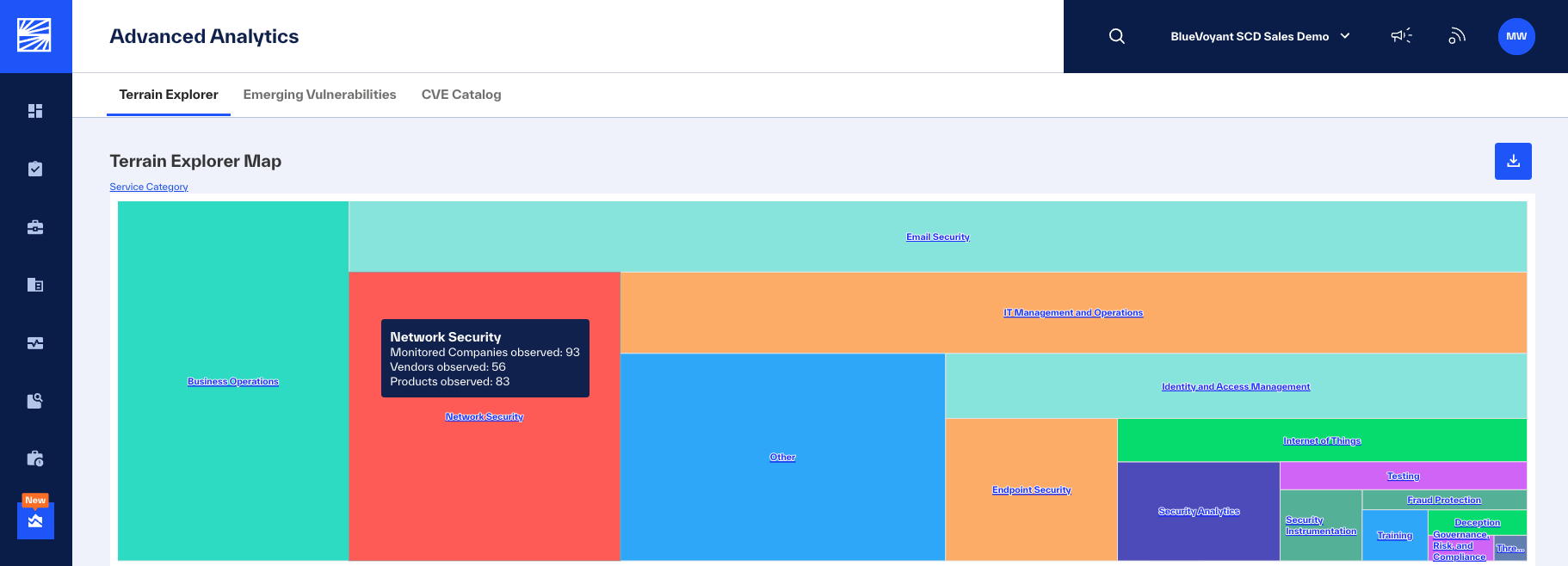 |
Vendor Dependency lets you go through the observed products and vendors, by industry recognized service categories.
To see observed vendors, click a Service Category. In the results, click again to see observed products that fit filters of monitored companies.
For example, if click the Email Security category, it updates both the Vendors Dependency tree-map and the Vendor Data table, to show all Email Security services in use.
Network Security - Products that protect a company network from unauthorized access, intrusions, and other threats.
Endpoint Security - Products that protect end-user devices (desktops, laptops, and mobile devices) from cybersecurity threats through technology such as: antivirus, endpoint detection and response (EDR), extended detection and response (XDR), managed detection and response (MDR), and other security technology.
Identity and Access Management - Products that enforce a framework of policies to make sure that users have appropriate access to a company’s technology resources.
IT Management and Operations - A general category of products for the organization and management of software, technologies, and services used by a company.
Business Operations - A general category of products for business operations, continuity, sales, and collaboration.
Fraud Protection - Online or deployed software that detects illegitimate and high-risk online activities. These tools continuously monitor user behavior and calculate risk to identify potentially fraudulent purchases, transactions, or access.
Email Security - The prediction, prevention, detection, and response framework for email protection against attacks unauthorized access. Email security spans gateways, email systems, user behavior, content security, and supporting processes, services and adjacent security architecture.
Security Analytics - Software, algorithms, data collection, data aggregation, and analysis tools for proactive threat detection and security monitoring.
Threat Intelligence - Products and services that deliver information about cybersecurity threats and related issues. The curation of information about identities, motivations, characteristics, and methods of threats, known as tactics, techniques and procedures (TTPs), enables better decisions and improves security technology, to reduce risk and the chance of being compromised.
Internet of Things - Managed IoT services for connectivity, data collection, analysis, and decision services that are necessary for connected products, such as cellular (2G, 3G, 4G/LTE, and 5G), satellite, LPWA networks (3GPP and non-3GPP) and managed field-area networks (FANs).
Training - Security awareness training software gives businesses online courses to train and assess their employees' security readiness. Many of these tools deliver simulated attacks or fraudulent emails to help employees better identify malicious content before they see it in real-life.
Governance, Risk and Compliance - GRC software manages the flow and accessibility of information in an organization. Businesses use GRC products to identify risks, implement policies, and track compliance.
Testing - Application Security Testing (AST) products and services that analyze and test applications for security vulnerabilities.
Deception - Deception technology software helps detect, analyze, and protect against unknown threats. It uses decoys, traps, lures, honeypots, and other deceptively attractive data sources, to let threat actors think they discovered vulnerabilities or valuable data.
Security Instrumentation - (aka deep security instrumentation) embeds sensors in applications to protect themselves from sophisticated attacks in real-time.
Other - Detections that are not in a service category.
The Vendor Data table shows observed detections for all service-categories, vendors and products.
Observation data. Observation data from each product detection is in Company Profile > Company Insights to see how and where the observation was derived.