Advanced Analytics - CVE Catalog
The CVE Catalog uses BlueVoyant detection to identify CVEs (Common Vulnerabilities and Exposures) in your vendor environment.
The Catalog is in the Client Portal > Advanced Analytics.
|
|

The CVE Catalog shows all CVEs that affect your monitored third-party companies.
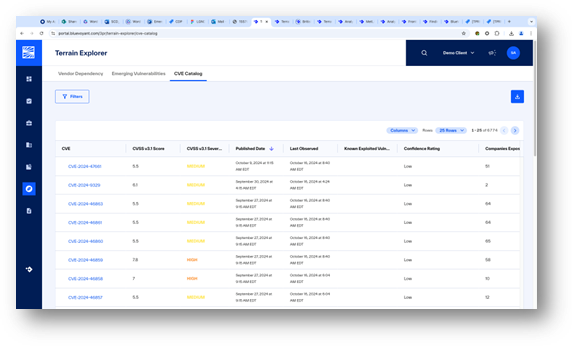 |
CVE – Identifier assigned to each CVE (in the format
CVE-year-1234567)CVSS v3.1 Score - A Common Vulnerability Scoring System (CVSS) v3.1 score is a value between 0.0 and 10.0 for the severity of a vulnerability
CVSS v3.1 Severity - The Common Vulnerability Scoring System (CVSS) v3.1 severity ratings are:
None: 0.0
Low: 0.1–3.9
Medium: 4.0–6.9
High: 7.0–8.9
Critical: 9.0–10.0
Published Date – Date when the CVE was published by the National Vulnerability Database (NVD)
Last Observed – Date when the CVE was last detected by BlueVoyant in your environment of monitored companies
Confidence Rating – The BlueVoyant Analytics team assigns a confidence rating to each CVE.
Confidence:LOW - We can validate only a software version from the CVE data, and this does not give confidence that the CVE is a risk.
HIGH - We detected many elements of risk from the CVE. For example: services required to exploit the vulnerability, configurations that can be detected, and other detections that can be evidence of malicious actions. We have a lot of confidence that this CVE describes a real risk.
MEDIUM - The version is enough to detect the vulnerability in systems, but a malicious exploit requires much more.
Known Exploited Vulnerability – If the CVE was added to the KEV Catalog (Known Exploited Vulnerability catalog)
KEV List Date = Date when the CVE was added to KEV catalog
Companies Exposed – Total monitored companies affected by this CVE